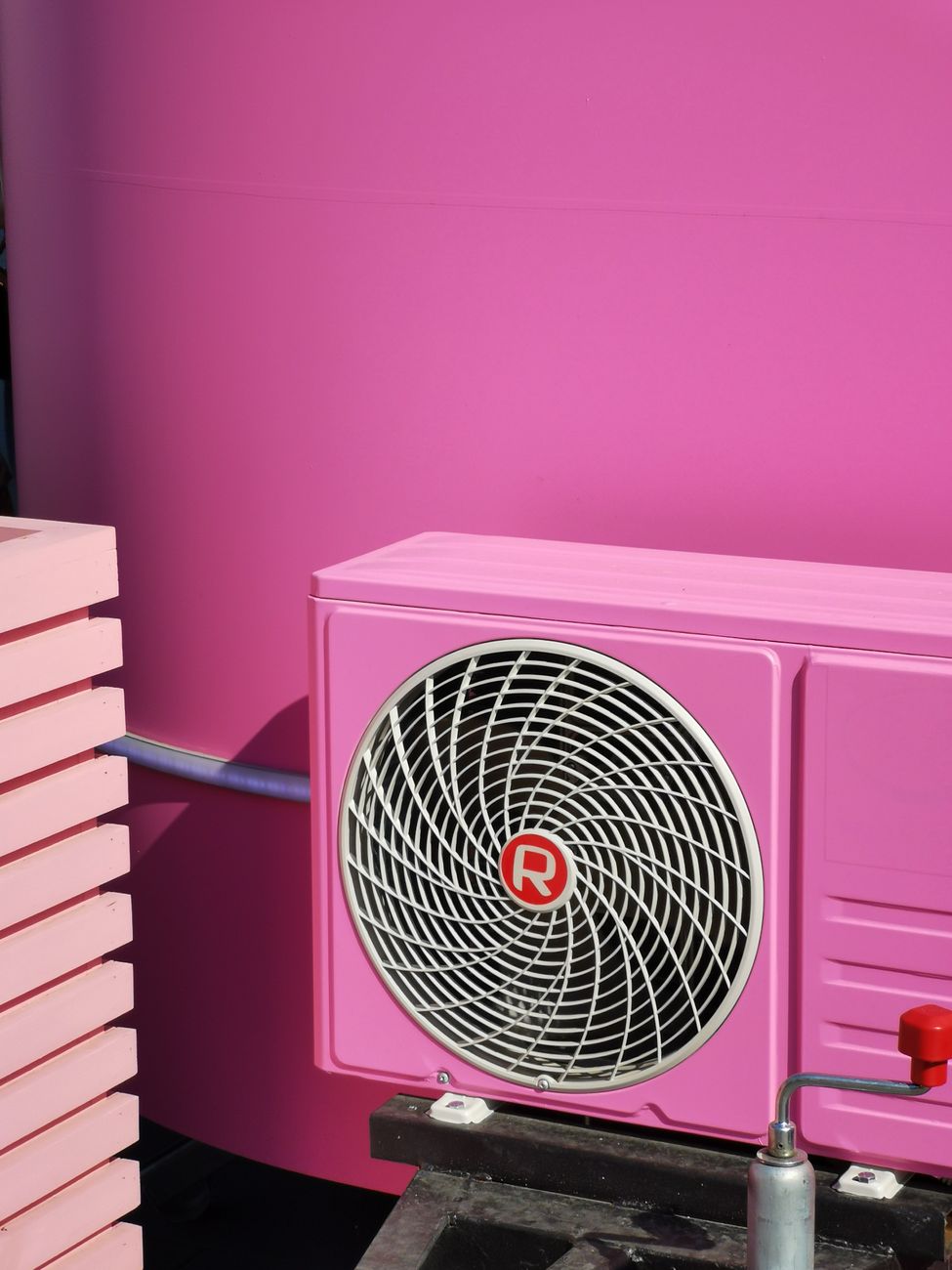
An air conditioner is a good everyday example of GCSE Physics. It links energy transfer, heating, cooling, particles, evaporation and condensation.
A common mistake is to think that an air conditioner simply “makes cold air”. It is better to think of it as a machine that removes thermal energy from the room and transfers it outside.
Inside the air conditioner is a special fluid called a refrigerant. This fluid is useful because it can easily change from a liquid to a gas and back again.
The refrigerant flows around the air conditioning system in pipes. In the indoor part of the unit, the refrigerant is cold. A fan blows warm room air over the cold pipes.
Thermal energy transfers from the warmer room air to the colder refrigerant. As the room air loses energy, its temperature decreases. This cooler air is then blown back into the room.
The refrigerant absorbs this thermal energy and evaporates. Evaporation means changing from a liquid to a gas. This change of state needs energy, so the refrigerant takes energy from the air in the room.
The refrigerant then carries this energy to the outdoor part of the air conditioner. Outside, the refrigerant releases the energy to the surrounding air.
As the refrigerant loses energy, it condenses back into a liquid. Condensation means changing from a gas to a liquid. This releases energy to the surroundings, which is why the outside part of an air conditioner often blows out warm air.
The refrigerant then returns to the indoor unit and the cycle repeats.
The key idea is that an air conditioner does not destroy thermal energy. It moves thermal energy from inside the room to outside the building.
The energy transfer can be written simply like this:
thermal energy from room air → refrigerant → outside air
A strong GCSE explanation would be:
An air conditioner cools a room by removing thermal energy from the air inside the room. Warm room air passes over cold pipes containing refrigerant. Energy transfers from the warm air to the refrigerant, so the air cools down. The refrigerant carries this energy outside, where it releases the energy to the surroundings. This cycle repeats, so the room gradually becomes cooler.
This is a useful GCSE Physics example because it shows that cooling is not about “adding cold”. Cooling happens when thermal energy is removed.
 The Physics Question Bank
Leave a comment