Course: Separate Physics only | Tier: Foundation + Higher | Linked practical: Required Practical 9: Light
📌 KEY DEFINITIONS – learn them word for word
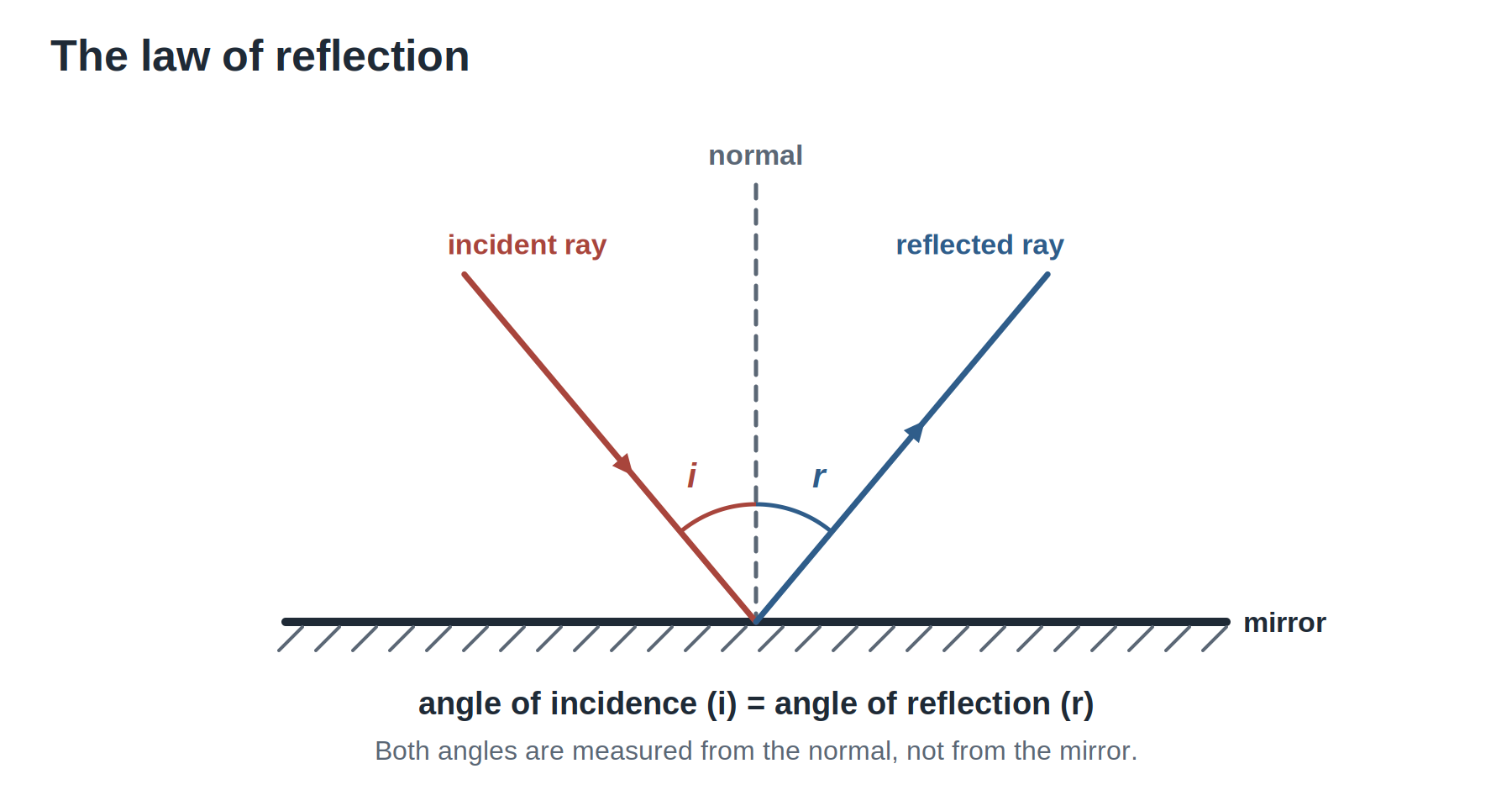
Normal: a line drawn at 90° to the surface at the point where the ray hits it. All angles are measured from the normal.
Law of reflection: the angle of incidence equals the angle of reflection.
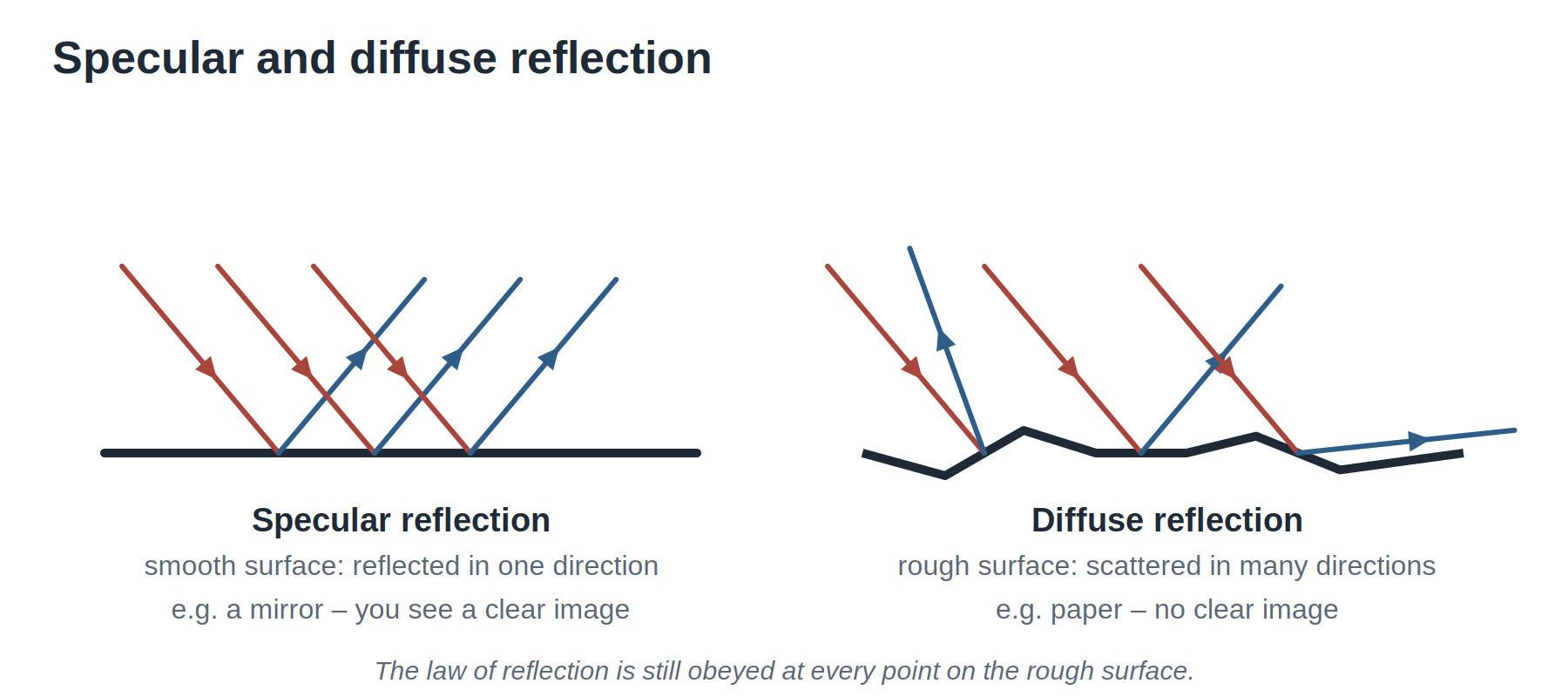
Specular reflection: reflection from a smooth surface in a single direction. Diffuse reflection: reflection from a rough surface, which scatters the light in many directions.
Notes
What happens at a boundary
When a wave meets a boundary between two different materials, it can be:
- Reflected: the wave bounces back off the surface.
- Absorbed: the wave’s energy is transferred to the material (often heating it).
- Transmitted: the wave passes through the material, often being refracted as it does.
Which of these happens (and how much) depends on the wavelength of the wave and the materials involved. Often all three happen at once.
✏️ Copy into your book
- The normal is a line drawn at 90° to the surface where the ray hits it. Draw it as a dashed line.
- Angle of incidence (i): the angle between the incoming ray and the normal.
- Angle of reflection (r): the angle between the reflected ray and the normal.
- Law of reflection: angle of incidence = angle of reflection
Drawing a ray diagram for reflection
- Draw the mirror as a straight line.
- Draw the incoming ray with an arrow pointing towards the mirror.
- Draw a dashed normal at 90° to the mirror where the ray hits.
- Measure the angle of incidence from the normal with a protractor.
- Draw the reflected ray at the same angle on the other side of the normal, with an arrow pointing away.
Images in a plane mirror
The image in a flat (plane) mirror is virtual, upright, the same size as the object, the same distance behind the mirror as the object is in front, and laterally inverted (left and right are swapped).
Specular and diffuse reflection
A smooth surface such as a mirror gives specular reflection: all the rays are reflected in the same direction, so you see a clear image. A rough surface such as paper gives diffuse reflection: each ray still obeys the law of reflection, but the normals point in different directions, so the light is scattered and no clear image forms.
Questions
Q1 (F) Name three things that can happen when a wave meets a boundary between two materials.
Show answer
It can be reflected, absorbed or transmitted.
Q2 (F) What is the normal?
Show answer
A line drawn at 90° to the surface at the point where the ray hits it.
Q3 (F) State the law of reflection.
Show answer
The angle of incidence equals the angle of reflection.
Q4 (F) A ray of light hits a mirror with an angle of incidence of 35°. What is the angle of reflection?
Show answer
35°
Q5 (F/H) A ray hits a mirror at an angle of 20° to the mirror surface. What is the angle of reflection?
Show answer
Angles are measured from the normal, so the angle of incidence is 90° − 20° = 70°. Angle of reflection = 70°.
Q6 (F/H) Describe the image you see in a plane mirror.
Show answer
Virtual, upright, the same size as the object, the same distance behind the mirror as the object is in front, and laterally inverted.
Q7 (H) Explain why you can see your reflection in a mirror but not in a sheet of white paper.
Show answer
The mirror is smooth, so it gives specular reflection: all rays are reflected in the same direction and a clear image forms. Paper is rough, so it gives diffuse reflection: the rays are scattered in many directions and no clear image forms.
Q8 (H) Sunlight falls on a dark tarmac road. Explain what happens to most of the light and what effect this has.
Show answer
Most of the light is absorbed rather than reflected. The energy is transferred to the thermal energy store of the road, so the road heats up.

